How Many Families Are Displaced Due to Gentrification
Gentrification is rapidly reshaping many cities beyond the United States, including Texas, displacing vulnerable residents and changing the cultural character of communities.
What is Gentrification?
Gentrification is a procedure of neighborhood change where higher-income and higher-educated residents movement into a historically marginalized neighborhood, housing costs rise, and the neighborhood is physically transformed through new higher-finish construction and building upgrades, resulting in the deportation of vulnerable residents and changes to the neighborhood's cultural grapheme.
A core driver of gentrification in the U.S. has been the strong and growing need for central urban center living by more than affluent households, which in turn drives upwardly housing prices in cardinal city neighborhoods. This broad-calibration demographic shift is actively underway in many Texas cities, including Houston, Austin, and Dallas. City planning, economic development initiatives, and taxation incentives fostering redevelopment in central neighborhoods are considered to be additional factors influencing gentrification.
Neighborhoods impacted past gentrification accept been shaped historically by decades of discriminatory public policies and private real estate practices that undermined property values, facilitated substandard living conditions, and generated racially segregated housing patterns. These neighborhoods' lower holding values, location in the urban core near good jobs and transit, and historical and cultural character are all factors that are making them more attractive to newcomers and susceptible to redevelopment.
Understanding Displacement
In that location are several types of displacement that can occur in gentrifying neighborhoods:
Directly displacement occurs when residents can no longer afford to remain in their homes due to rise housing costs. Residents may besides exist forced out by lease non-renewals, evictions, eminent domain, or physical conditions that render homes uninhabitable as investors look redevelopment opportunities. While displacement occurs routinely in low-income neighborhoods, when it occurs in the context of new development and an influx of wealthier residents, the displacement becomes a characteristic of gentrification.
Indirect displacement refers to changes in who is moving into a neighborhood as low-income residents motion out. In a gentrifying neighborhood, when homes are vacated by low-income residents, other low-income residents cannot afford to motion in because rents and sales prices have increased. This is also called exclusionary displacement. Low-income residents tin also exist excluded equally a result of discriminatory policies (for example, a ban on tenants with housing vouchers) or changes in land use or zoning that foster a change in the graphic symbol of residential development, such equally eliminating units for households without children.
Cultural deportation occurs every bit the scale of residential alter advances. Shops and services shift to focus on new residents, the grapheme of the neighborhood is transformed, and the remaining residents may feel a sense of dislocation despite remaining in the neighborhood.
When understood as a process rooted in the uneven treatment of particular neighborhoods and racial and ethnic groups, addressing gentrification-induced displacement requires attending to former residents who have already been displaced, current residents, and future residents. Some cities accept created "correct of return" or preference policies that focus on former residents or those at gamble of existence displaced. At the same time, it is important to ensure that in the future other low-income persons and persons of color will also be able to access the opportunities in gentrifying neighborhoods and that the scale of change does not erase cardinal aspects of neighborhoods that allow both current and future residents to experience at home.
Who Is Impacted past Gentrification and Displacement?
As communities seek to craft tools for reducing displacement in gentrifying neighborhoods, it'south of import to first identify which neighborhoods in the city are already gentrifying or are susceptible to gentrifying, as well as the groups of residents in those neighborhoods who are virtually vulnerable to deportation in the face of rising housing costs. Cities can and so more effectively tailor their tools to address the needs of those neighborhoods and residents. For example, many tools to address gentrification are more effective in neighborhoods in the earlier stages of gentrifying, while other tools are more viable in the later stages. And some tools are more effective in addressing the displacement of renters, while others are more effective in addressing the displacement of homeowners.
When cities create economic development projects and implement major public infrastructure projects, understanding a neighborhood's vulnerability to deportation likewise helps a city recognize when to comprise deportation mitigation strategies upwards front into those projects, rather than waiting until later. In one case gentrification picks up steam, reducing displacement becomes much more difficult.
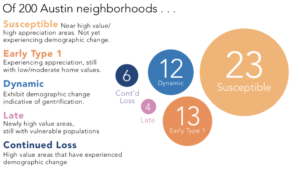
A number of methodologies are bachelor for analyzing which neighborhoods are gentrifying and the level of gentrification occurring, every bit well as which neighborhoods are at the greatest chance of gentrifying. The analysis for the Metropolis of Austin by faculty from The Academy of Texas at Austin (https://sites.utexas. edu/gentrificationproject/) built upon a methodology developed by Professor Lisa Bates at Portland State University. The City of Denver's gentrification analysis also built off of Professor Bates' methodology. The gentrification analysis for the cities of Minneapolis and St. Paul combined three different methodologies, including Bates' methodology. The Urban Displacement Heart has as well developed a useful methodology that has been used in many cities.
As for identifying groups of residents who are almost vulnerable to displacement in gentrifying neighborhoods, there are five principal indicators of vulnerability. Renters, depression-income households, persons of color, households headed by a resident without a higher degree, and families with children in poverty are, overall, more vulnerable to displacement from rising housing costs than other groups of residents.
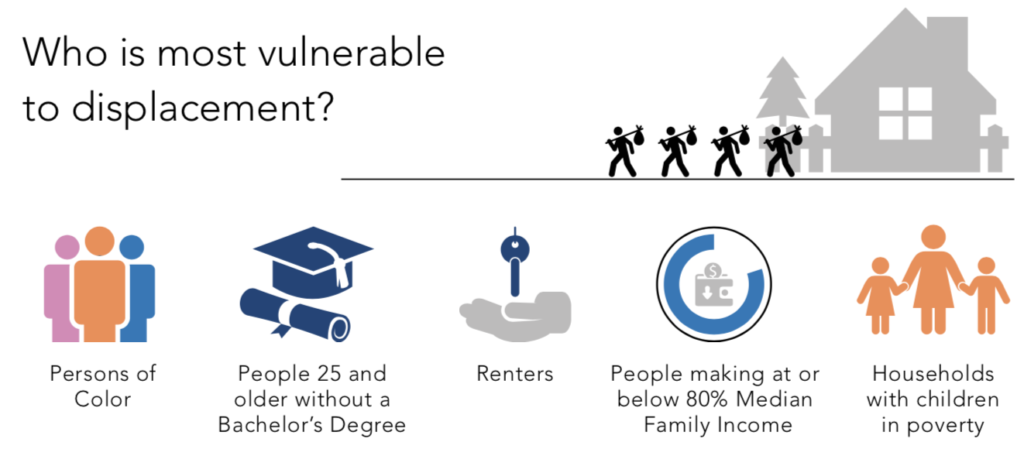
Source: https://sites.utexas.edu/gentrificationproject/understanding-gentrification-and-displacement/
0 Response to "How Many Families Are Displaced Due to Gentrification"
Post a Comment